



Beyond the 5 µg/l Threshold: Why European Importers Are Abandoning Brass for Certified Stainless Steel Faucets Under the New EU Drinking Water Directive
In the European commercial plumbing and sanitaryware import sector, regulatory compliance is no longer a localized procedural formality; it has hardened into an existential operational barrier. Under the European Drinking Water Directive (EU 2020/2184), the permissible lead concentration threshold at the consumer tap has been slashed from 10 µg/l down to an uncompromising 5 µg/l, accompanied by the mandatory enforcement of the European Positive Lists for metallic materials.
For European wholesale distributors, commercial mechanical contractors, and hospitality specifiers, this regulatory contraction fundamentally shatters the commercial viability of traditional gravity-cast brass. In high-volume culinary installations, catering facilities, and luxury multi-family developments, continuing to import brass fixtures—even those marketed as "chemically de-leaded"—introduces catastrophic legal liabilities, severe customs impoundments at European ports, and devastating post-installation recall overhead. Insulating commercial supply chains against this regulatory cliff requires abandoning lead-dependent copper alloys entirely and anchoring procurement in certified, medical-grade austenitic stainless steel.
The Metallurgical Dead-End of Washed Brass: Why 5 µg/l Destroys Conventional Sourcing
To understand why the 5 µg/l ceiling is paralyzing traditional brass importers, procurement directors must examine the physical metallurgy of copper-zinc alloys. Standard sanitary brass relies on lead additions (often 1.5% to 3.0%) to provide lubrication during high-speed CNC machining and to seal micro-porosities inherent in gravity die-casting.
To satisfy earlier, more lenient standards, legacy factories deployed topical acid-washing (chemical pickling) to strip free surface lead from the internal waterways. However, this is an inherently unstable stopgap. Acid-washing creates a depleted surface layer that gradually dissolves when subjected to aggressive, chloride-heavy or acidic municipal water. Under prolonged overnight stagnation—the exact testing protocol mandated by European compliance laboratories—internal dezincification erodes the boundary matrix, releasing trapped subsurface lead directly into the standing water column.
The physical surface area of the fixture exponentially multiplies this chemical migration risk. In high-throughput commercial culinary prep stations, installing a heavy-duty commercial spring pre rinse Kitchen Faucet involves extensive internal wetted channels, articulated spray heads, and high-pressure flex lines. If manufactured from washed brass, the sheer internal surface area inevitably causes static lead leaching to breach the strict 5 µg/l parameter.
As we established in our foundational metallurgical briefing—[Beyond the Surface: The Structural and Metallurgical Realities of Brass vs. Stainless Steel Faucets] —attempting to engineer lead out of brass creates severe casting embrittlement and catastrophic stress-corrosion cracking. Compliance cannot be achieved through chemical band-aids; it demands an elemental baseline that contains zero lead from the melt.
Solid Austenitic Purity: The Absolute Zero Legal Shield
At INOXBATH, we resolve the European compliance dilemma through raw elemental purity. We construct our commercial and architectural fluid-control assemblies exclusively from certified SUS304 and SUS316 austenitic stainless steel via precision investment casting and five-axis CNC boring.
This is not a "low-lead" compromise engineered to scrape beneath 5 µg/l; it is an elemental, absolute-zero matrix. Austenitic stainless steel derives its machinability and structural strength from nickel, chromium, and molybdenum—not toxic heavy metal additives. Chemical analysis confirms 0.00% lead content within our solid metal lattice. Consequently, under prolonged immersion testing, our internal waterways yield a certified 0.0 µg/l lead migration rate, permanently insulating European importers from the shifting parameters of European Chemicals Agency (ECHA) positive lists and national surveillance audits.

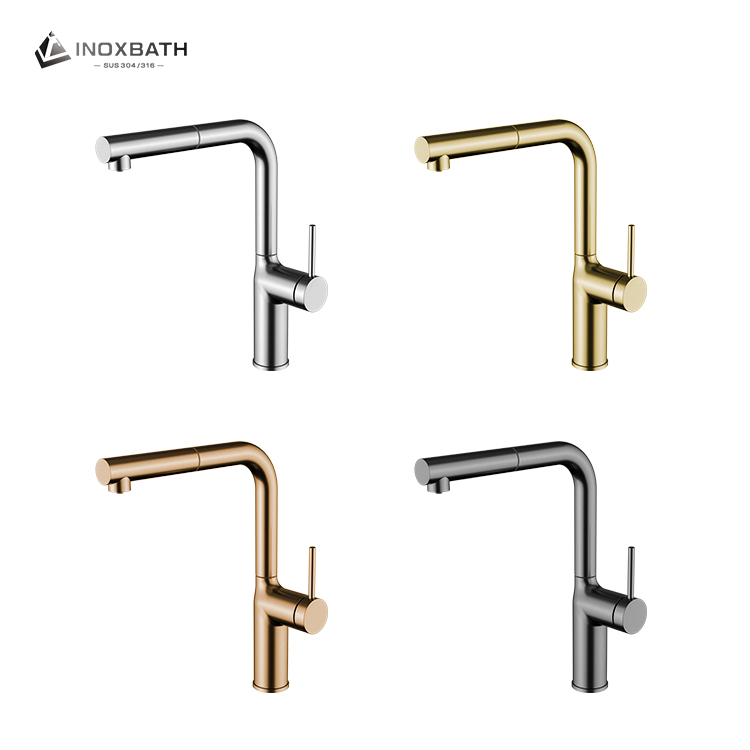
This certified metallurgical safety integrates seamlessly across our high-demand ergonomic configurations. For contemporary residential projects and secondary scullery prep zones where spatial flexibility is paramount, specifying a 360 degree swivel high arc pull out Kitchen Tap delivers maximum clearance and frictionless multi-angle rinsing without introducing galvanic leaching points.
Furthermore, when an architectural specifier or luxury boutique hotel demands high-contrast industrial elegance, installing our heavy-duty gunmetal grey commercial spring Kitchen Tap couples commanding visual presence with diamond-hard Physical Vapor Deposition (PVD) durability. Because our PVD vacuum chambers deposit metallic ions directly onto solid, non-porous stainless steel substrates rather than chemically pitted brass, the fixture delivers lifetime resistance to commercial sanitizers while upholding absolute drinking water purity.
| Compliance & Engineering Metric | Legacy "Low-Lead" / Washed Cast Brass | European DWD 2026/2036 Threshold | INOXBATH Investment Cast SUS304/316 |
| Elemental Lead in Alloy | 0.25% to 1.50% (Requires acid pickling) | Restricted via European Positive Lists | 0.00% Absolute Zero (No lead additives in melt) |
| Static Lead Leaching Rate | 6.0 µg/l to 18.0 µg/l (Fails under stagnation) | Mandatory Maximum: 5.0 µg/l | Certified 0.0 µg/l (Undetectable) |
| Material Degradation Mechanism | Dezincification pitting & stress corrosion cracking | Strict market surveillance penalties | Native chromium oxide () self-healing passivation |
| Wetted Surface Risk (Pre-Rinse / High-Arc) | High surface area accelerates heavy-metal migration | Immediate import seizure upon port testing | Micro-bored, mirror-polished laminar channels; zero drag |
| European Commercial TCO Impact | High risk of port bans, product recalls & warranty claims | Direct liability on the European importer of record | Total regulatory immunity; streamlined customs clearance |
The regulatory trajectory of the European Union is irreversible: tolerance for toxic heavy metals in drinking water infrastructure is reaching its end. By substituting lead-compromised brass with INOXBATH’s certified solid stainless steel faucets, European wholesale importers and mechanical contractors permanently eliminate compliance friction, protect their balance sheets against recall liabilities, and secure an unassailable commercial advantage in an increasingly regulated marketplace.
📩 [European sanitaryware importers, wholesale distributors, and mechanical engineering contractors seeking to insulate their supply chains from EU Drinking Water Directive non-compliance are invited to audit our metallurgical test records. To request certified ICP-MS lead-extraction laboratory reports, download CAD/BIM submittal files, or initiate an OEM supply dialogue for certified stainless steel kitchen and basin fixtures, collaborate directly with the INOXBATH engineering desk at www.inoxbath.com/contact-us/]