



Form Follows Metallurgy: A Procurement Guide to Investment Casting and Powder Metallurgy in Stainless Steel Faucets (Part 1)
In the global procurement of premium commercial plumbing hardware, a flawless brushed surface finish is merely the final act of a highly calibrated manufacturing sequence. While the exterior texture dictates aesthetic appeal and fingerprint resistance, the true operational lifespan of a stainless steel faucet is decided much earlier in the production cycle: during blank forming.
For engineering specifiers and high-volume distributors, evaluating a vendor requires looking beneath the surface chemistry and assessing how the raw metallic structure is sculpted.
Two primary methodologies dominate the fabrication of stainless steel plumbing components—Investment Casting (Lost-Wax Casting) and Powder Metallurgy (PM). These processes are not mutually exclusive; rather, they serve distinct structural roles within a balanced supply chain.
This technical brief, the first of a two-part series, deconstructs the foundational physics, strategic applications, and risk-mitigation profiles of both forming methodologies.
The Master Class of Complex Geometry: Investment Casting for Fluid Enclosures
To achieve the tortuous, curved geometries required for modern internal waterways and integrated valve housings, the plumbing industry heavily relies on investment casting. Operating on the historical principles of lost-wax replication amplified by modern robotic precision, this process stands as the absolute benchmark for producing the primary structural shell of a faucet.
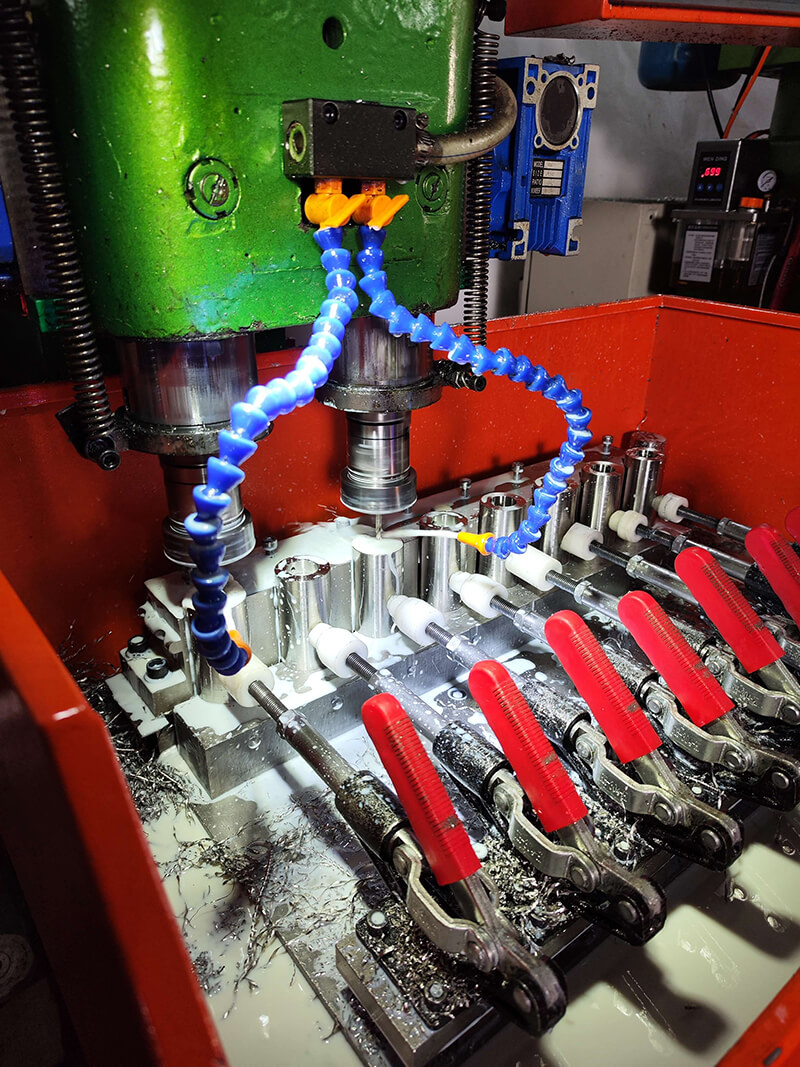
The workflow demands rigorous process control. It begins with the injection of sacrificial wax into high-precision dies to create an exact replica of the faucet body. These wax patterns are assembled into a structural "tree" and repeatedly dipped into specialized refractory ceramic slurries, layered with fine sand, and dried to form a robust, multi-layered ceramic shell.
Once the inner wax is thermally evacuated, the empty ceramic mold is fired at high temperatures to withstand the thermal shock of molten metal. High-purity Stainless Steel 304 or 316L is then induction-melted and gravity-poured into the pre-heated vitrified cavity.
From a structural engineering perspective, the commercial justification for investment casting lies in its geometric independence and material density:
Unrestricted Three-Dimensional Flow Channels
Because the internal core of the ceramic mold can be configured into intricate, continuous curves, investment casting allows for seamless internal fluid dynamics. This eliminates the sharp, milled angles that cause turbulent water flow, localized pressure drops, and accelerated cavitation erosion inside the valve.
Hydraulic Integrity Under Extreme Stress
The continuous, uncompromised metallic matrix of a properly cast component ensures exceptional pressure containment. After undergoing solid-solution annealing, these castings possess isotropic mechanical properties capable of routinely handling hydrostatic test pressures exceeding 1.6 MPa. This structural uniformity mitigates the risk of catastrophic field blowouts in high-rise commercial installations.
Optimal Base Substrate for Brushed Finishes
With a native surface roughness averaging Ra 3.2 to 6.3 μm, investment castings provide a highly uniform, low-defect surface plane. This minimizes the volume of aggressive grinding required downstream, protecting the structural wall thickness and ensuring an immaculate grain alignment during the final mechanical brushing phase.
The Geometry of Efficiency: Powder Metallurgy for Micro-Kinematics
While investment casting excels at sculpting large, hollow, and organic enclosures, the economics and mechanics shift when fabricating the dense, high-precision internal components of a faucet assembly. For parts such as internal cartridge levers, lock nuts, structural retention rings, and decorative accent caps, Powder Metallurgy (PM) introduces unparalleled dimensional consistency.
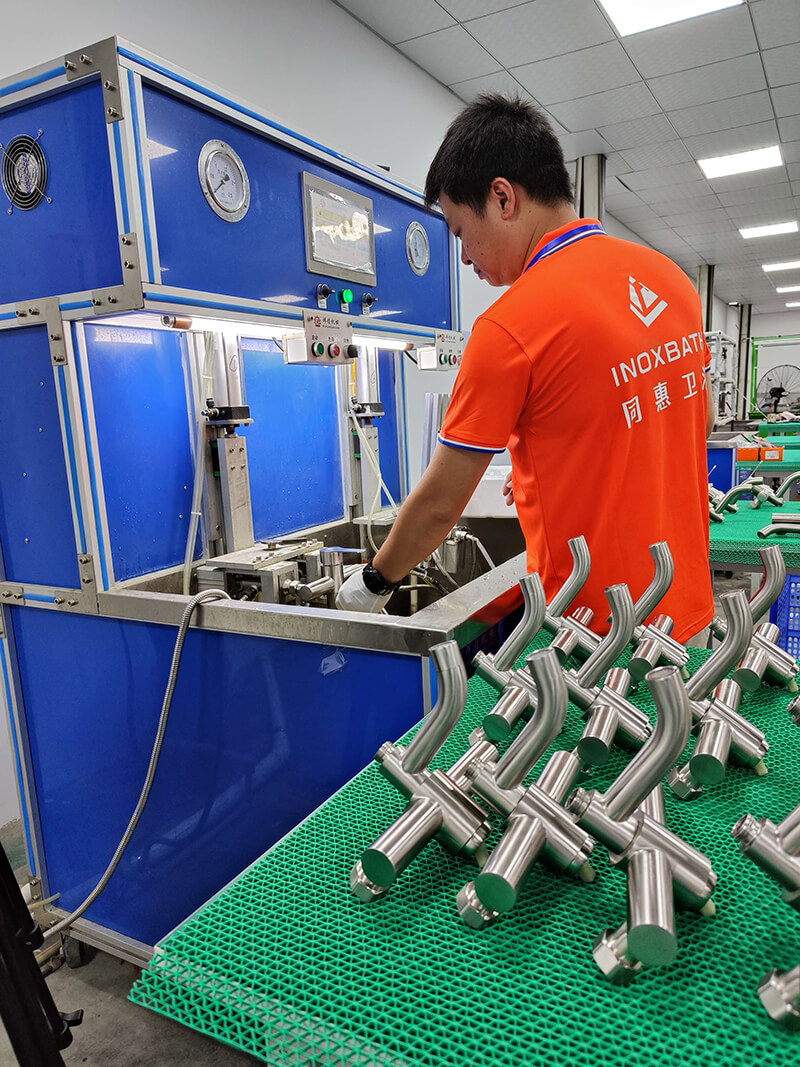
The physics of Powder Metallurgy bypass the liquid phase entirely. High-purity stainless steel powder is precisely blended with specialized lubricants and fed into hard-tooling steel dies. Under immense mechanical pressure, the powder is compacted into a "green" state component that mirrors the finalized dimensions.
This green part is then transferred into a continuous-belt, atmosphere-controlled sintering furnace operating just below the melting point of the alloy (typically between 1100°C and 1300°C). At these elevated thermal thresholds, solid-state diffusion occurs: the individual metal particles lock together at their atomic boundaries, synthesizing a high-strength, semi-dense component.
The operational advantages of incorporating PM components into a faucet ecosystem are deeply rooted in volume economics and manufacturing precision:
Near-Net-Shape Utilization Rates
Powder metallurgy operates at a material utilization efficiency exceeding 95%. By compressing the material directly into its final shape, the process eliminates the extensive raw scrap generation, high tooling wear, and prolonged machine hours associated with multi-axis CNC machining of solid bar stock.
Microstructural Repeatability
Once a hard-die profile is calibrated and compaction pressures are locked, the dimensional variance from the first part to the hundred-thousandth is virtually non-existent. This micron-level repeatability ensures that internal locking mechanisms and mechanical interfaces fit seamlessly during high-speed automated assembly lines, drastically lowering factory defect rates.
The Inherent Porosity Boundary
Despite its fiscal and dimensional strengths, PM possesses a defining characteristic that restricts its application to non-water-bearing components: residual micro-porosity. Sintered steel naturally retains microscopic interconnected voids. If a standard PM component is exposed directly to pressurized municipal water lines, these micro-pores act as capillary paths, causing progressive weeping, internal localized crevice corrosion, and premature structural failure.
While these pores can be sealed via secondary polymer resin impregnation or compacted through expensive Hot Isostatic Pressing (HIP), doing so strips the process of its cost-advantage. Consequently, premium manufacturers restrict PM strictly to structural kinematics and internal components, avoiding its use in primary pressure-containing shells.
Decoding the Microstructural and Magnetic Fingerprint
For a procurement officer conducting a factory audit or receiving batches of components, distinguishing between these two methodologies goes beyond visual inspection. The structural divergent pathways leave permanent physical markers.
Investment castings that have undergone comprehensive solution treatment exhibit a fully austenitic atomic structure, making them entirely non-magnetic or only weakly responsive to high-strength magnetic fields.
Conversely, standard pressed-and-sintered PM components frequently exhibit a distinct micro-magnetic signature. This is caused by the intense cold-working friction of the compaction phase and the specific cooling rates of sintering atmospheres, which often induce localized ferritic phases within the steel matrix.
Understanding these microstructural variances is critical when mapping out long-term corrosion resistance strategies, particularly in commercial environments exposed to aggressive cleaning agents or variable municipal water chemistries.
Looking Ahead: Moving From Fundamentals to Financials
Choosing between investment casting and powder metallurgy is not a question of identifying a superior technology; it is a discipline of strategic deployment. At INOXBATH, our engineering workflow integrates both methodologies in perfect harmony—leveraging the absolute geometric freedom of lost-wax investment casting for our primary fluid enclosures, while deploying the micron-level precision of powder metallurgy for internal kinematics to guarantee long-term asset value.
In the upcoming Part 2 of this manufacturing whitepaper series published by INOXBATH (www.inoxbath.com), our technical team will transition from these foundational physics into hard operational and economic data. We will map the exact microstructural density profiles of both forming methods, analyze the precise financial thresholds for tooling capitalization, and examine how specific atmospheric sintering controls shield our stainless steel hardware against aggressive chloramine exposure in municipal water systems.
[Click Here to Connect with the INOXBATH Engineering Team at www.inoxbath.com to Discuss Your OEM Custom Forming Requirements]