



Chrome Is Losing the Spec War — and PVD Warm Finishes Are the Reason
For forty years, the faucet industry ran on a single unspoken assumption: chrome was the finish, and everything else was a deviation. Wholesalers stocked it because it was cheap to plate and impossible to get wrong. Builders specified it because it never clashed. The word "stainless steel" in a catalog meant one thing — a bright, cold, mirror-polished surface that looked identical on a $50 faucet and a $500 one.
That assumption is now bleeding share on every axis that matters. Google Trends tells the story in a single line: searches for brushed gold, champagne, and gunmetal faucet finishes climbed from 35 to 65 over twelve months. Matte black did not just hold — it crossed from trend to baseline configuration. And behind every one of those warm, matte, non-chrome surfaces sits a finish technology that most buyers still cannot reliably distinguish from a paint job.
The Finish Is the Last Regulatory Surface You Control
A faucet is a series of surfaces, and the finish is the one the market judges first and the one that fails most visibly. Internal waterways can hide their defects for years behind a wall of plumbing. A finish cannot hide anything. It is the first thing a specifier photographs, the first thing a homeowner touches, and the first thing an installer's warranty claim photographs when something goes wrong.
This is the same logic we laid out when examining the aerator — the small component at the very end of the spout that carries disproportionate regulatory weight. The finish operates the same way at the other end of the product lifecycle. It is the last surface between your factory and a chargeback, and in 2026 it has become the surface where most of the industry's cost-cutting hides.
The tell is simple. A warm tone or a matte black that costs meaningfully less than its PVD faucet finish equivalent is, almost without exception, a paint. Wet-sprayed or powder-coated. It photographs beautifully. It passes the first month. Then the edges begin to lose color where hands and cleaning cloths wear against them, the detergent starts to lift the pigment at the rim, and the underlying substrate — whatever it was — begins to show through. The chargeback follows, and the brand that sourced it eats the claim.
| Finish | 2025–26 Share | Trajectory | Failure Mode That Matters |
| Chrome | 42.5% | Declining | Pitting at plating defects, hard-water etching |
| Brushed nickel | 22% | Flat | Fingerprint visibility, uneven hand-rubbed grain |
| Matte black | 15% | Rising (paint → PVD) | Peeling when paint-based |
| Brushed gold / copper | 10% | Rising fastest | Color shift if not PVD-bonded |
| Gunmetal | 5% | Rising | Fading at high-touch zones |
The shift embedded in that table is not that chrome is dying — it still holds the plurality. It is that the growth is all on the warm and matte side, and the growth is happening at exactly the moment when the market has not yet learned to distinguish a gunmetal faucet finished in vacuum-deposited metal from one finished in a spray booth. That gap is where margin gets made and where liability gets born.
What "PVD" Actually Buys You at the Spec Table
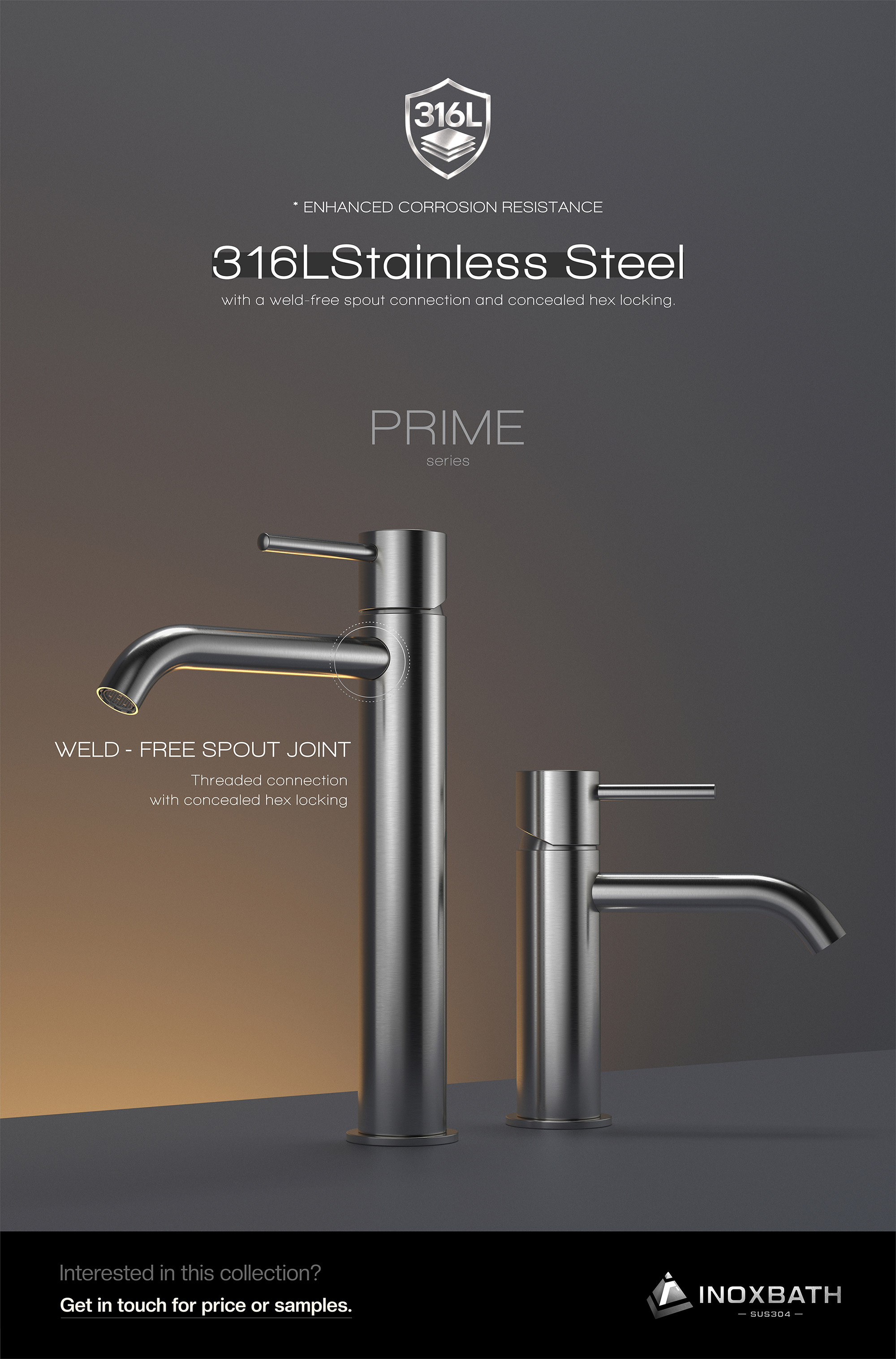
Physical Vapor Deposition is not a coating in the way most buyers imagine a coating. There is no wet layer sitting on top of the substrate, waiting to be peeled. The color is a thin metallic film — titanium-based, most often — deposited atom by atom in a vacuum chamber, bonded to the surface rather than resting on it. Strip it with an aggressive solvent and there is nothing to strip; the finish is the material.
That distinction translates into three numbers a project buyer should ask for, because they are the numbers an AHJ or a hotel operator will eventually care about. First, salt spray resistance: a properly executed PVD finish on a stainless substrate holds beyond 200 hours of neutral salt-spray exposure without visible corrosion, where a painted warm finish fails at a fraction of that. Second, the stainless base matters as much as the film on top of it — a stainless steel 316 faucet body brings molybdenum into the alloy, which is what buys real resistance to the chloride attack that eats 304 in coastal or high-salinity installations, and it is the reason intergranular corrosion stays out of the conversation on marine-spec projects. Third, and least glamorous but most telling, the housekeeping number: in hotel field testing, a warm PVD surface wiped clean in roughly ten seconds, against forty-five for a mirror chrome surface that shows every water spot and fingerprint.
| Attribute | Painted Warm Finish | Vacuum-Deposited PVD Finish |
| Bonding | Surface layer, mechanical | Atomic film, molecular bond |
| Salt spray | Fails early, often <100 hrs | 200+ hrs neutral salt-spray |
| Edge wear | Color loss at rims and corners | Uniform color retention |
| Cleaning (hotel field) | N/A — degrades under chemicals | ~10 sec vs 45 sec chrome |
| Substrate honesty | Hides low-grade base | Requires clean 304/316 base |
| Submittal support | Weak documentation | MTRs + finish cert traceable |
For an OEM faucet program, the commercial meaning is this: PVD is not a color option you tick on a quotation. It is a manufacturing discipline that starts at the base metal — you cannot deposit a clean PVD film on a substrate with poor surface integrity, any more than you can plate chrome over a casting defect and expect it to hold. That is why the finish conversation, done properly, always walks backward into the material conversation: what the body is cast from, how it is polished, whether the MTRs behind the heat are available, and whether the finish line holds color within the tolerance a multi-unit project requires across every fixture it ships.

Match the Color Your Project Demands, Then Let Us Hold It
We do not expect a project to arrive with its finish problem already solved. Most come to us the other way around — a render, a designer's swatch, or a competitor's part number, and a requirement that the color hold across a run of fixtures installed over multiple floors and months.
If you are specifying a PVD faucet finish in brushed gold, champagne, gunmetal, or a custom tone, bring us the reference and the substrate requirement. We will return color-master samples, a salt-spray test report, and MTRs traceable to the heat — the submittal package an owner or AHJ will actually accept, rather than a catalog page and a promise. Private-label and OEM faucet color development is a dialogue we open routinely. Start it at www.inoxbath.com/contact-us/