



Beyond the 1.5 GPM Baseline: Future-Proofing Commercial Plumbing Against Tightening WaterSense and Lead-Free Mandates
In the commercial plumbing procurement landscape, regulatory compliance is no longer a static checkbox; it is a rapidly moving target. For North American developers, hotel brands, and massive distribution networks, the legal baseline for what constitutes an acceptable plumbing fixture is undergoing a seismic shift. Relying on outdated hardware architectures based on 1.5 Gallons Per Minute (GPM) or standard "low-lead" brass exposes multi-million-dollar projects to catastrophic compliance liabilities, Authority Having Jurisdiction (AHJ) rejections, and devastating post-installation retrofit costs.
As the Environmental Protection Agency (EPA) tightens its grip and individual states enact aggressively pure water mandates, specifying hardware is no longer about aesthetic preference—it is about Total Cost of Ownership (TCO) and establishing absolute immunity to future legislative volatility.
The Approaching 1.2 GPM Standard: Navigating WaterSense 2.0
The trajectory of water conservation laws is unyielding. While the current EPA standard for a WaterSense certified faucet in residential and commercial lavatory applications stands at a maximum of 1.5 GPM, the regulatory horizon is already shifting. The proposed WaterSense Version 2.0 draft aggressively targets a maximum discharge rate of 1.2 GPM. Although formal adoption was temporarily paused in early 2025 for further deliberation, the strategic direction is unmistakable.
By 2026, market data indicates that over 80% of all lavatory faucets sold in the United States already carry the WaterSense label. Furthermore, global hospitality giants such as Marriott (Autograph Collection) and Hilton (Tapestry Collection) have unilaterally integrated stringent WaterSense parameters into their non-negotiable brand standards. For a high-volume wholesale distributor,importing fixtures that merely scrape by current 1.5 GPM limits is a massive inventory risk. Major retail chains and commercial specifiers are actively rejecting non-certified, high-flow imports at the loading dock.
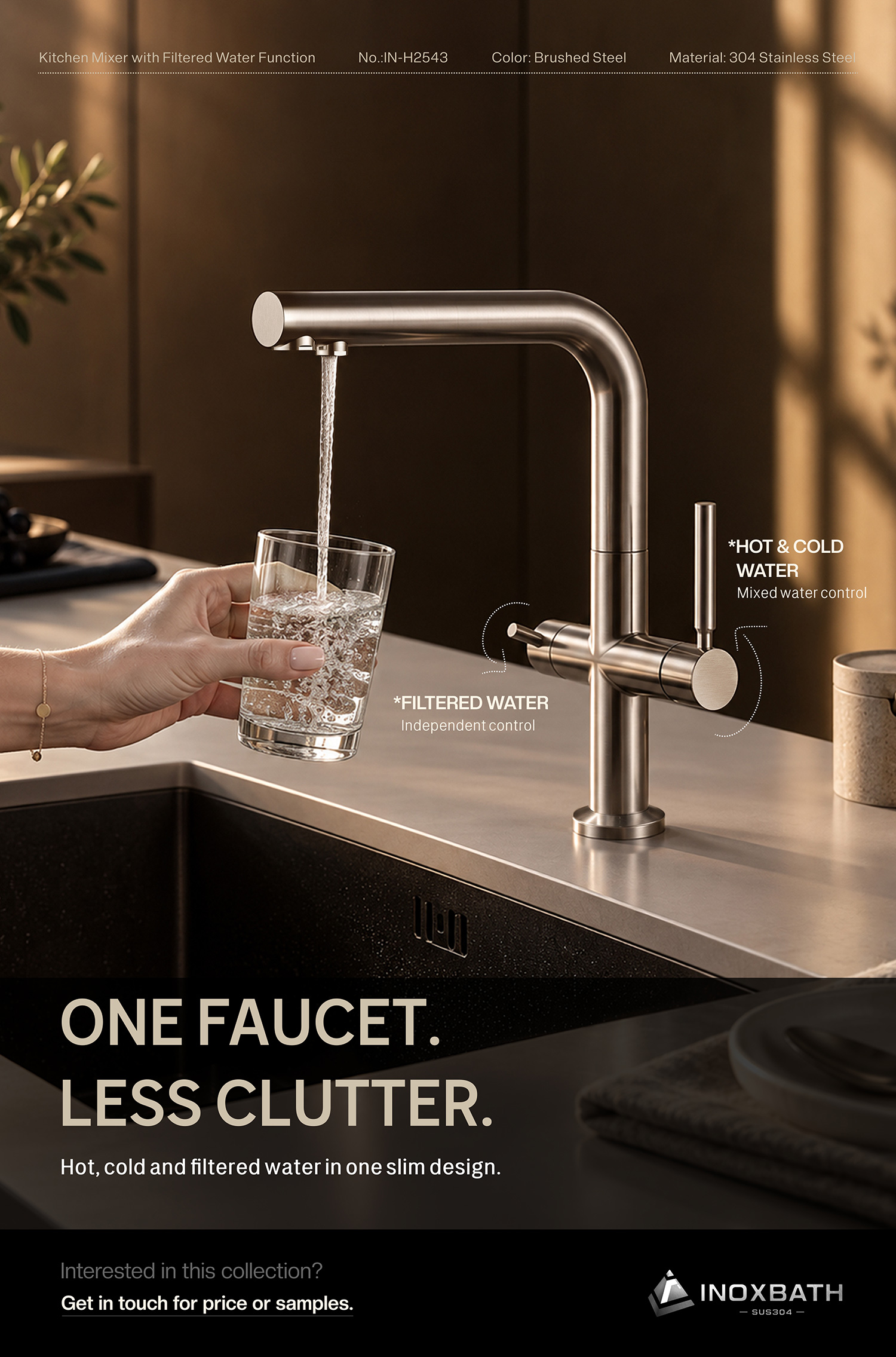
To future-proof our partners, INOXBATH engineers fluid dynamics well ahead of the legislative curve. By integrating advanced pressure-compensating aerators (PCA) deep within our CNC-machined stainless steel housings, we deliver robust, tactile water volume at 1.2 GPM, ensuring maximum LEED v4.1 point generation without sacrificing the end-user washing experience.
The Zero-Lead Imperative: Why "Low-Lead" Brass is Obsolete
Simultaneous with tightening flow rates is the absolute eradication of lead in drinking water systems. Under the federal Safe Drinking Water Act (SDWA), a fixture is legally defined as a lead free faucet if its wetted surface contains no more than a weighted average of 0.25% lead. However, progressive states are unilaterally shattering this federal ceiling. California’s aggressive AB 100 legislation and Vermont’s S.40 mandate are effectively pushing allowable lead extraction limits toward absolute zero. For project directors relying on traditional gravity-cast brass, this is a toxicological nightmare. Brass relies heavily on lead additives for machinability. To meet the 0.25% standard, factories must execute complex acid-washing to strip surface lead—a temporary band-aid that can fail over years of aggressive municipal water erosion, triggering catastrophic California Proposition 65 (Prop 65) warning liabilities and class-action lawsuits.
INOXBATH bypasses this chemical liability through raw metallurgical purity.As we detailed in our foundational guide—[Beyond the Surface: The Structural andMetallurgical Realities of Brass vs. Stainless Steel Faucets] we construct our core fluid-bearing bodies exclusively from SUS304 and SUS316 austenitic stainless steel via precision investment casting.
This is not a "0.25% low-lead" compromise; this is a 100% natural, zero-lead matrix. An INOXBATH stainless steel casting simply does not contain lead in its elemental composition.
| Regulatory Dimension | Traditional "Low-Lead" Brass | INOXBATH Solid 304/316 Stainless Steel | Commercial TCO Implication |
| SDWA / NSF 61 Compliance | Scrapes the 0.25% maximum limit; requires acid washing | 0.00% Lead (Absolute Zero) | Total immunity to Proposition 65 warning requirements. |
| Material Toxicity | High risk of lead leaching under acidic/hard water erosion | Medically inert, food-grade austenitic matrix | Guarantees multi-generational drinking water safety. |
| Future Legislative Risk | Vulnerable to tightening state laws (e.g., California AB 100) | Permanently Immune to any future heavy-metal restrictions | Secures multi-year project pipelines from sudden compliance bans. |
Whether you are specifying a highly regulated CUPC faucet for a North American commercial high-rise or a multi-family residential complex, specifying INOXBATH stainless steel ensures your plumbing infrastructure outlasts the building's structural warranty, completely insulated from the shifting winds of environmental law.
Architectural specifiers, commercial developers, and high-volume wholesale distributors seeking to insulate their supply chains from tightening EPA and SDWA regulations are invited to audit our compliance architecture. To review our certified NSF/ANSI 61 reports, request precision CAD submittals, or initiate a bespoke OEM design dialogue for 1.2 GPM / Zero-Lead projects, collaborate directly with the INOXBATH engineering desk at www.inoxbath.com/contact-us/